
FT article on expanding NATO nuclear sharing...
More nuclear deterrence options for SACEUR, more assurance for Allies

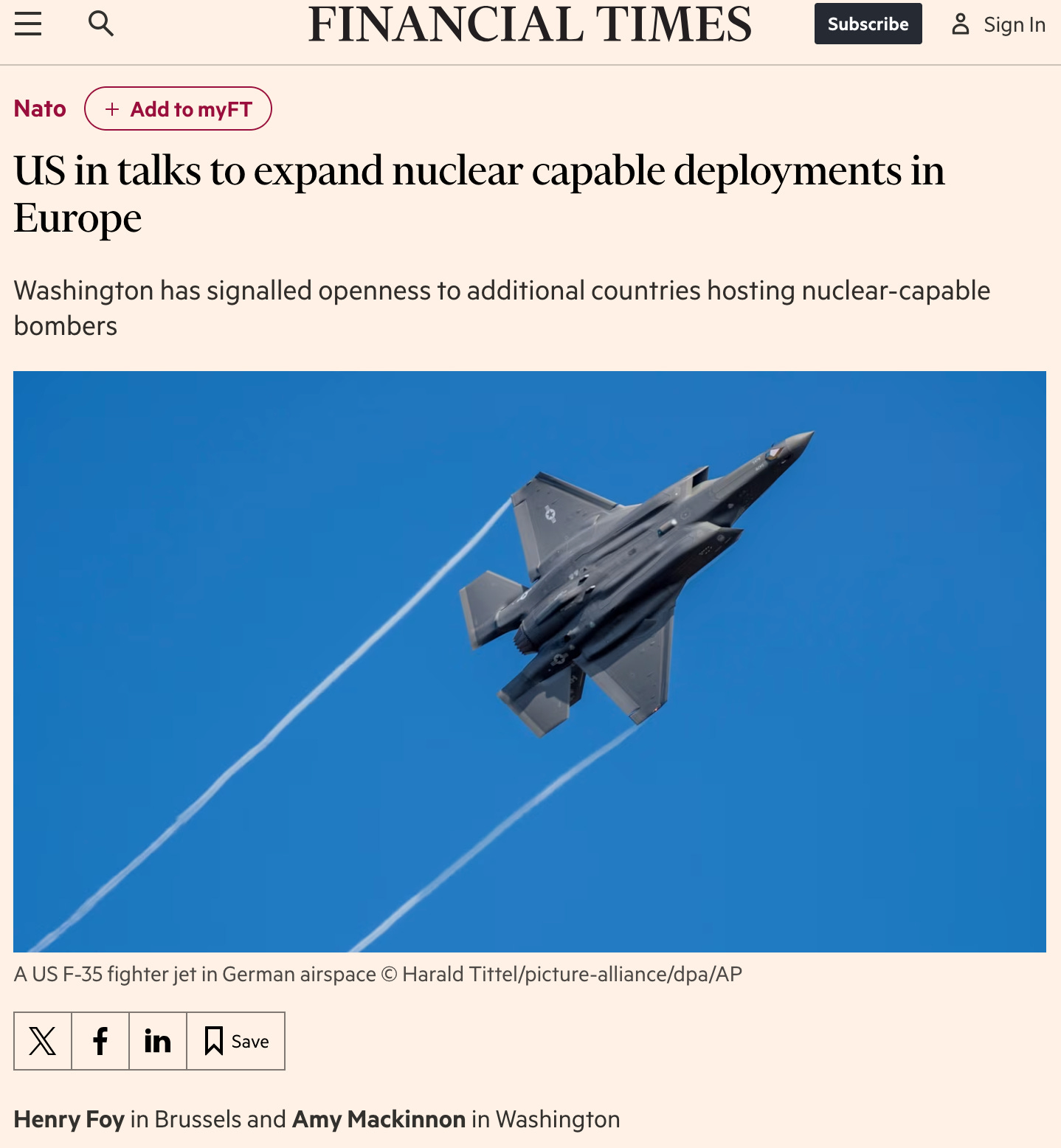
On 2 June 2026, the Financial Times published an article by Henry Foy and Amy Mackinnon claiming that the US has initiated a dialogue with Allies on
“whether to deploy nuclear weapons in additional European NATO states” to offset potential reductions in US conventional support in Europe and reassure Allies”
(I know, it’s behind a paywall, but I’ll give you what you need to know here).
It is a clickbait headline, likely indicating that at the 21-22 May 2026 Foreign Ministerial in Helsingborg, Sweden, the NATO Allies received a report on changes to the NATO nuclear sharing arrangements to strengthen Allied deterrence, which I am guessing was a tasker from the 2024 Washington Summit agreement on a new NATO nuclear policy.
The 2024 new NATO nuclear policy is driven by the 2019 new NATO military strategy, the Concept for Deterrence and Defence of the Euro-Atlantic Area DDA) and all the changes that stem from there. I wrote the detailed history of the changes in NATO’s defense policy and plans, if you want to know more.
But for our purposes, what normally happens with a new policy is the nations task the committes to come up with options that then get funded and implemented. The FT article is picking up the whiff of the options that are being discussed at NATO, probably endorsed by the Foreign Ministers for further work in the Nuclear Planning Group and the High Level Group.
Some of the options raised in the FT article are being driven, obviously, by a combination of the increase in Allied spending on defense, the need for Europeans to provide more support to NATO nucelar deterrence, as well as I’m sure a fair bit of jealousy and resentment over France’s unbelievable success in driving new defense and nuclear assurance arrangements all through Europe. Good on ‘em.
In the final analysis, the FT article does not indicate that Allies are seriously considering stationing US nuclear weapons on the territory of Allies that currently are not hosts to nuclear weapons. It is highly likely that they are discussing additional deterrence options, including certifying more Allies’ aircraft to delivery US nuclear weapons. They also might have made some decisions related to Dispersed Operation Bases (DOB) and Untethered Operations Bases (UOB) - I’ll explain that all later.
And what the FT article means to me is that a list of options was just endorsed by the NATO Foreign Ministers in Helsingborg, which will then be endorsed by the Defense Ministers at the Ministerial in Brussels scheduled for 18 June 2026 for final agreement by the Heads of State and Government at the 2026 NATO Ankara Summit along with an implementation plan that will be tasked to the NPG and HLG along with a progress report by the end of the year.
I mean, probably.
But let’s get to some facts.
Quick aside: what we know needs to be done
As I mentioned, headline aside, the actual changes under consideration far more modest than the permanent stationing of nuclear weapons in, say Poland. They might be talking about that, but to do so would be quite complicated, and there are still pretty significant changes needed to NATO’s nuclear posture to strengthen deterrence in the face of a potential reduced US committment to NATO and stretched US resources.
Fortunately, Artur Kacprzyk and I listed the top ten desperately-needed changes to NATO’s deterrence back in 2024:
Broader Participation in Conventional Support for Nuclear Operations (CSNO)
Strengthening Conventional Response and Counterforce Options
Improved French and UK Contributions to NATO’s Nuclear Deterrent
Nailed it.
The FT article is about changes one and two. Number three is underway, as you can see by my article on STEADFAST NOON, and number four is underway with the NATO SecGen himself attending and speaking about nuclear exercises (bring back NPG Communiqués, please). Numbers 5, 8, and 9 are not in any obvious way moving ahead, but 6, 7, and 10 are all hot items.
Back to the FT article before I strain my shoulder patting myself on the back!
How to exaggerate your headline, walk back your claims, and make factual errors all along the way…
Currently, according to Foy and Mackinnon, the US stores nuclear weapons on the territory of six states:
Belgium, Germany, Italy, the Netherlands, Turkey, and the UK.
And these permanent deployments are part of NATO’s nuclear sharing programme, which means these countries are:
approved to host US DCA and “forward-deployed” nuclear bombs. These bombs are under US protection, with Washington retaining sole authorisation for their use.
It goes on to make some odd claims, including that the US is:
signalling openness to additional deployments beyond the existing six countries hosting nuclear-capable bombers
The article clarifies that NATO DCA currently consists of:
F-35s, F-15 and Tornado jets
BUT THEN, the article takes back its initial startling claim that new permanent basing was under discussion and says instead that talks:
“may not lead to any changes in nuclear-sharing arrangements,” but “would potentially allow more countries to host so-called dual-capable aircraft (DCA) to deliver nuclear strikes”
And finally:
A second person familiar with the discussions said that an agreement to expand US nuclear hosting was not imminent
Let’s have some facts, shall we?
I’m a pedant and proud of it, so let’s start with terminology.
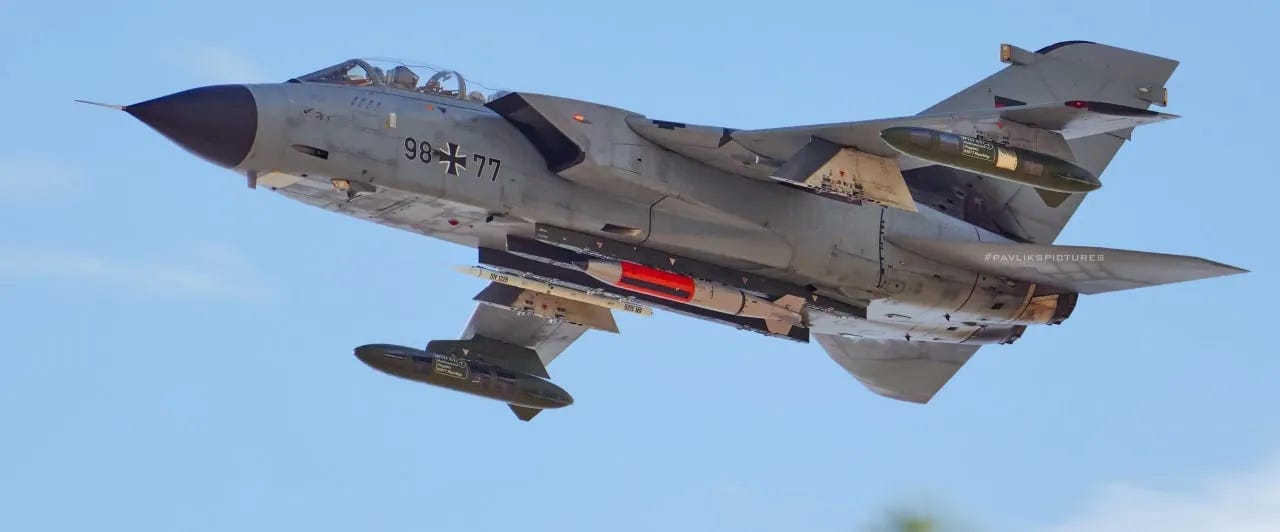
The article uses the wrong terminology - nuclear-capable bombers - and should use dual-capable aircraft (DCA). Also, they’re not bombers. DCA (meaning fighter jets capable of delivering conventional and nuclear bombs) are all considered in the broad category of combat aircraft, in the sub-category of fighter-bombers, certified to carry US-provided B61 bombs. DING
Then, the list of DCA states - while all six of the above-listed states (are reported to) host US forward-deployed nuclear weapons under US control, which is true, only two permanently host US-owned DCA: Aviano Air Base in Italy (F-16s of the 31st Fighter Wing) and RAF Lakenheath in the UK (the F-15Es Eagles of the 492nd and 464th Squadrons and the F-35A Lightning IIs of the 493rd and 495th Squadrons). So only two of the six states that host US nuclear bombs also host US DCA. DING
Turkey, Incirlik Air Base hosts US Air Force support units, but there are no permanently-assigned US combat aircraft (DCA or otherwise) from either the US or Turkey at Incirlik. Turkey left the DCA mission in 1995, so the bunkers at Incirlik instead serves as a nuclear storage facility where US and other Allied DCA can fly in to pick up B61s there to fly strike missions.
Four of the six Allies fly their own DCA aircraft at the bases with US bombs, including Italy, Belgium, Germany, the Netherlands. The UK is (re-)joining the DCA mission with its incoming purchase of 12 F-35As to be based at RAF Marham (and pick up their B61s at Lakenheath, presumably). It had its own WE.177 air-dropped nuclear bombs at RAF Marham, and when the UK decided to retire them, the US helpfully built WS3 vaults at Marham to hold B61s, but the UK withdrew from the nuclear mission in 2007 so they were never used.
On this whole last point on the UK rejoining the DCA family, I find it interesting that the FT includes the UK as a nuclear-basing/DCA Ally. I’ve raised this point on Twitter and Substack, namely that the US moved B61 to RAF Lakenheath in July 2023. I guess this is common knowledge now.
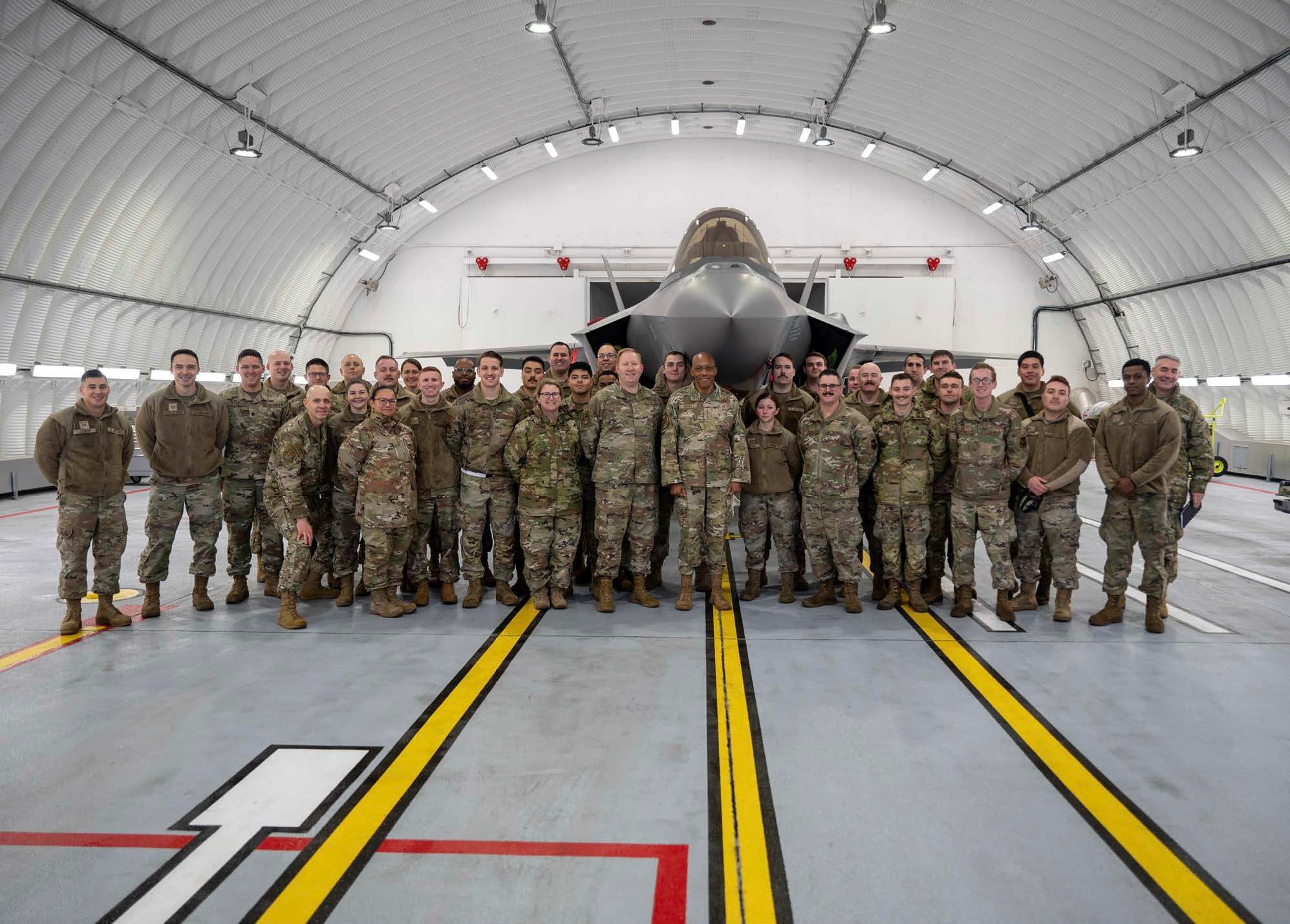
When they say NATO DCA includes the F-35, the F-15, and Tornado jets, ugh, kill me. What they mean is that the current fleet of aircraft certified for the DCA mission, US and Allied, includes the F-35A (the F-35B cannot carry B61s in their internal bays, and if they carry them on external bays, they lose their stealth profile), F-15Es (which is only flown by the US), Panvia Tornado PA-200 ECRs (flown by Germany and Italy) - and they forgot the F-16 C/D/MLUs (flown by Belgium).
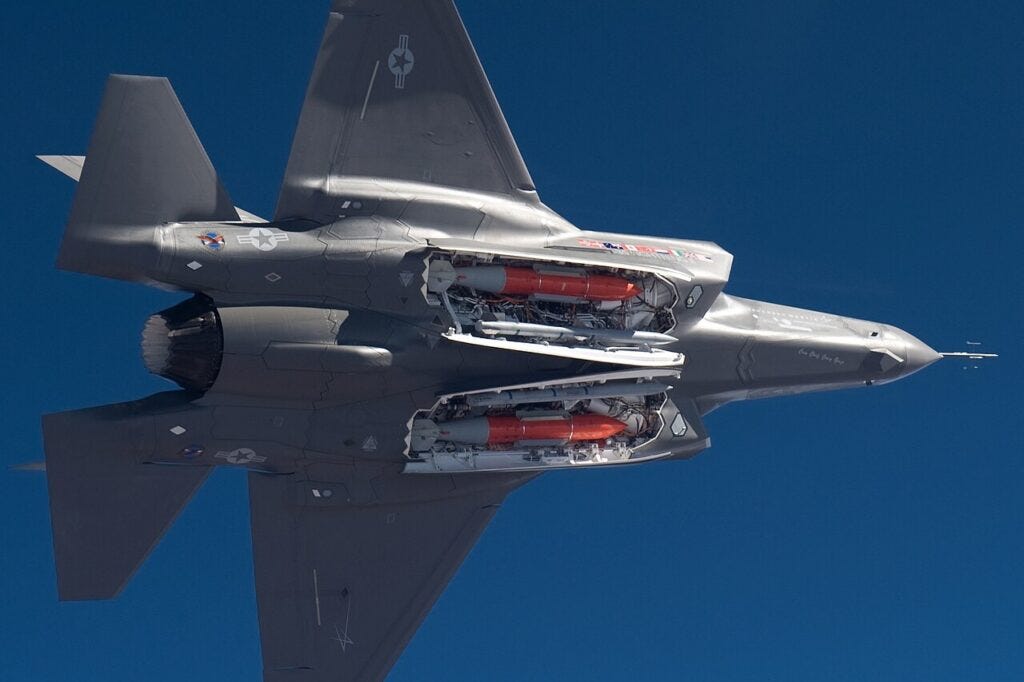
Previous NATO DCA include the F-86F/H, F-104G/CF-104, F-105D, FB-111A, F-4C, A-6, A-7, and F/A-18F.
So, what about the articles claims?
As for the FT article’s claim that the US might add more countries to those that store nuclear weapons, I find that hard to believe. Hence the article asserts that the US is open to the idea, and then walks it back saying that new “hosting” is not likely - meaning hosting of US nuclear weapons, but it does seem to say that new states participating in the DCA mission is possible.
One of your takeaways should be that the clickbait headline got you to read that NATO has taken mine and Artur’s advice and is adding more flexible basing options and more DCA to the NATO nuclear sharing mission.
But the idea that more Allies would permanently host US nuclear storage is highly unlikely, for now. Why?
US nuclear weapons storage in Europe
Let’s establish some facts about US nuclear storage in Europe. The US first began moving nuclear weapons onto foreign territory at Eisenhower’s direction in 1953. The first state, oddly, was France - French Morocco to be exact - with air-dropped bombs for US strategic bombers. They ended up staying a bit after Moroccan independence before coming home. The first NATO Ally to receive US nuclear weapons on their soil was, unsurprisingly, the UK (1954) followed by West Germany (1955). The US just did it at first, not really caring about host arrangements, as they took the position that existing US status of forces agreements covered it.
The US would re-examine host nation arrangements later that decade, but the Soviet threat was considered so massive at the moment that forward nuclear weapons to fulfill the first NATO Strategic Concept (MC 14/1, 1949) which promised to use “all types of weapons” against overwhelming Soviet conventional superiority - especially US-owned atomic weapons. The 1954 NATO Strategic Concept (MC 48) called for the “massive use” of tactical atomics to “prevent the rapid overrunning of Europe”.
So the US first moved aerial bombs, then artillery (rockets and shells), land mines, short and longer-range missiles, torpedos, land mines, anti-aircraft missiles and so on. The number of US nuclear weapons assigned to the forward defence of the NATO Alliance peaked at over 7,000 in 1970. But, with the end of the Cold War, President George HW Bush led the way on the Presidential Nuclear Initiatives with Gorbachev and then Yeltsin, reducing non-strategic nuclear weapons, so more than 98% of the US nuclear arsenal came home, leaving under 200 air-dropped bombs only in Europe today.
The WS3 storage vaults
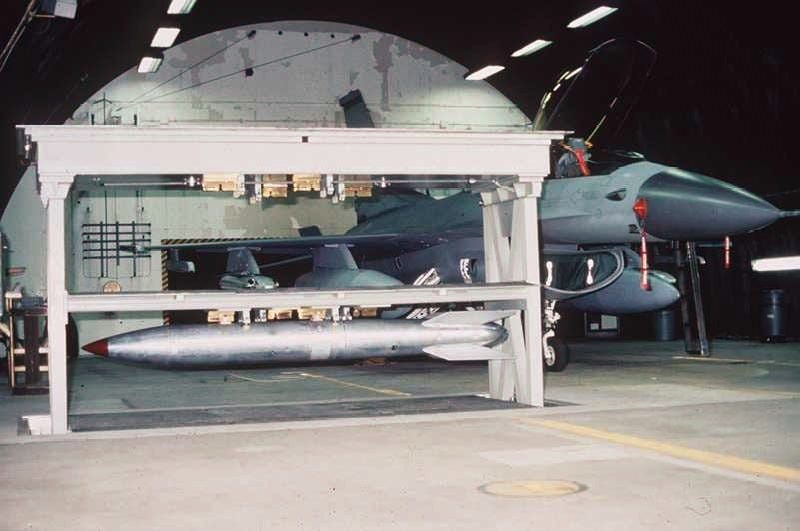
The US typically builds and maintains what is known as Weapon Storage and Security Systems (WS3) vaults in the floor of aircraft bunkers at DCA bases. The WS3 system was designed in the 1970s to replace older, less secure bunker arrangements for air-dropped bombs. These vaults were designed to store four bombs each, compatible with the B57, B61, B83s, and UK WE.177s. It is believed that the vaults also could store dismounted cruise missile warheads, but this capability was never used due to the INF Treaty.
At its peak, the US built 255 WS3 vaults at 15 facilities in Europe, capable of storing 1,020 bombs. If we only count the bases where the US currently is reported to store nuclear weapons, there are 120 vaults total, capable of storing 480 B61s.
The US legal basis for nuclear storage abroad
The basis for US nuclear storage on the territory of other countries is a what is know as a “Sec. 144b Atomic Energy Agreement,” that is an agreement between the United States and the proposed host on the Uses of Atomic Energy for Defense Purposes based on the US Atomic Energy Act of 158 (as amended). The US has at least a dozen of these agreements, including with Australia, Belgium, Canada, France, Germany, Greece, Italy, Netherlands, Turkey, and the UK, all signed between 1957 and 1962. They are considered treaties, and must receive advice and consent of Congress. These agreements cover word such as nuclear propulsion for naval vessels or what we would consider “nuclear sharing arrangements”, including planning and training the delivery or use of nuclear weapons.
It does not, however, allow for storage.
For that, you need a “National Stockpile” agreement (that is, the general provisions concerning support and storage of all nuclear weapons supplied by the United States). It includes provisions covering custody, security, safety, and release of the weapons, as well as cost sharing and construction criteria.
Bonus: France, Netherlands, Canada, and the UK all signed “third-party” agreements with the US on establishing stockpiles of nuclear weapons in West Germany for their forces to use in case of war. France dropped out of that arrangement by 1963, and the US, Belgium, Canada, the UK and West Germany signed an agreement on the continuing storage of nuclear weapons in West Germany.
To implement the Stockpile agreement and conduct nuclear sharing, you then need a Service-Level agreement between the particular armed services involved (air force, army, or navy) and the US Army Europe, Navy Europe, and US Air Force Europe (or, if it were in the Pacific…you get it). As of 1975, there were nine Allies with Army and Air Force sharing agreements (BE, CA, FR, FRG, GR, IT, NL, TU, UK) but only two with Navy agreements (NL and UK).
Wanna check my math? Read this, especially Annex H. It’s all declassified.
The current basing and storage of US nuclear weapons in Europe
Currently, according to DoD budget documents, the US maintains WS3 storage vaults at Kleine Brogel in Belgium, Buchel Air Base in Germany, Aviano and Ghedi Air Bases in Italy, Volkel Air Base in Netherlands, and Incirlik Air Base in Turkey, and RAF Lakenheath in the UK. We can estimate that far fewer than the 120 WS3 vaults constructed at these facilities are in use, as there are likely fewer than 200 B61s in Europe.
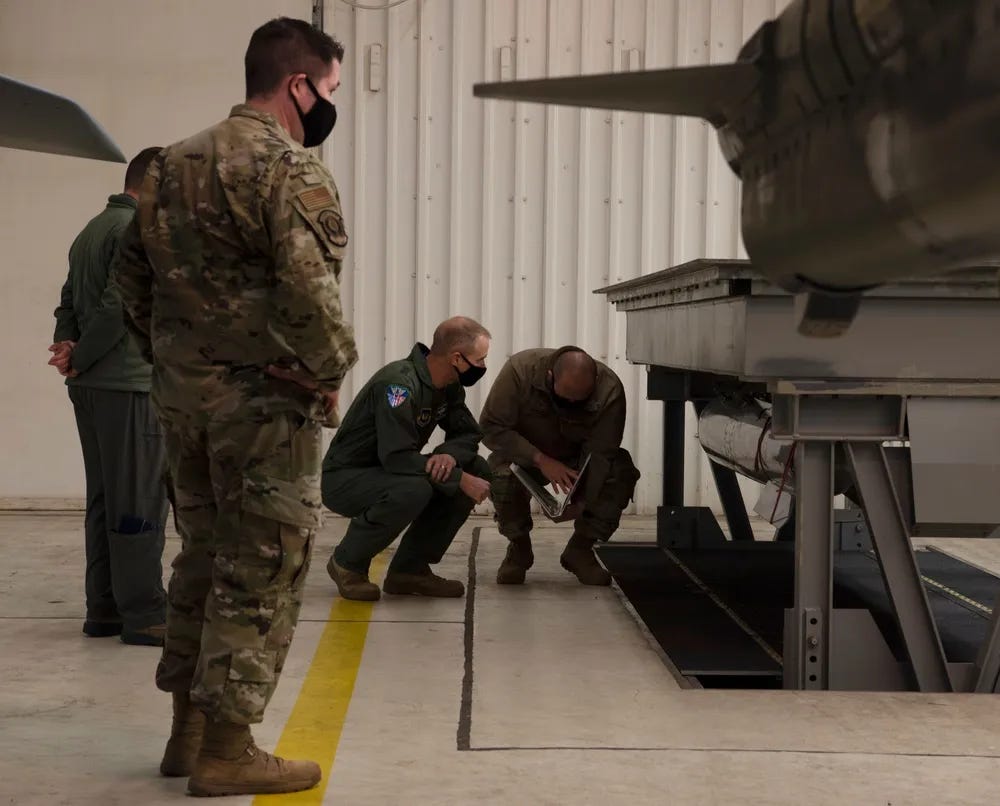
The US nuclear storage facilities in Europe are supported by US Air Force Munitions Squadrons or Munitions Support Squadrons (MUNSS):
31st Munitions Squadron: Aviano Air Base, Italy, serving the USAF 31st Fighter Wing (F-16s);
39th Weapons System Security Group: Incirlik Air Base, Turkey, serving the USAF 39th Air Base Wing (no aircraft assigned);
48th Munitions Squadron: RAF Lakenheath, United Kingdom, under USAF 48th Fighter Wing (F-15Es and F-35As);
701st Munitions Support Squadron: Kleine Brogel Air Base, Belgium, supporting the Belgian 10th Tactical Wing (F-16s);
702nd Munitions Support Squadron: Büchel Air Base, Germany, supporting German Taktisches Luftwaffengeschwader 33 (Tornado);
703rd Munitions Support Squadron: Volkel Air Base, Netherlands, supporting the Netherlands 312th and 313th Air Squadrons (F-35As);
704th Munitions Support Squadron (formerly of Araxos Air Base): Ghedi Air Base, Italy, supporting Italian 6º Stormo.
How could the US increase nuclear basing in Europe?
As I demonstrated earlier, permanent basing of nuclear weapons on the territory of additional Allies requires:
An Atomic Energy for Defense Purposes Agreement, ratified by Congress, based on the Atomic Energy Act of 1958, between the United States and the new host, and
A Stockpile Agreement on custody, modalities, and costs.
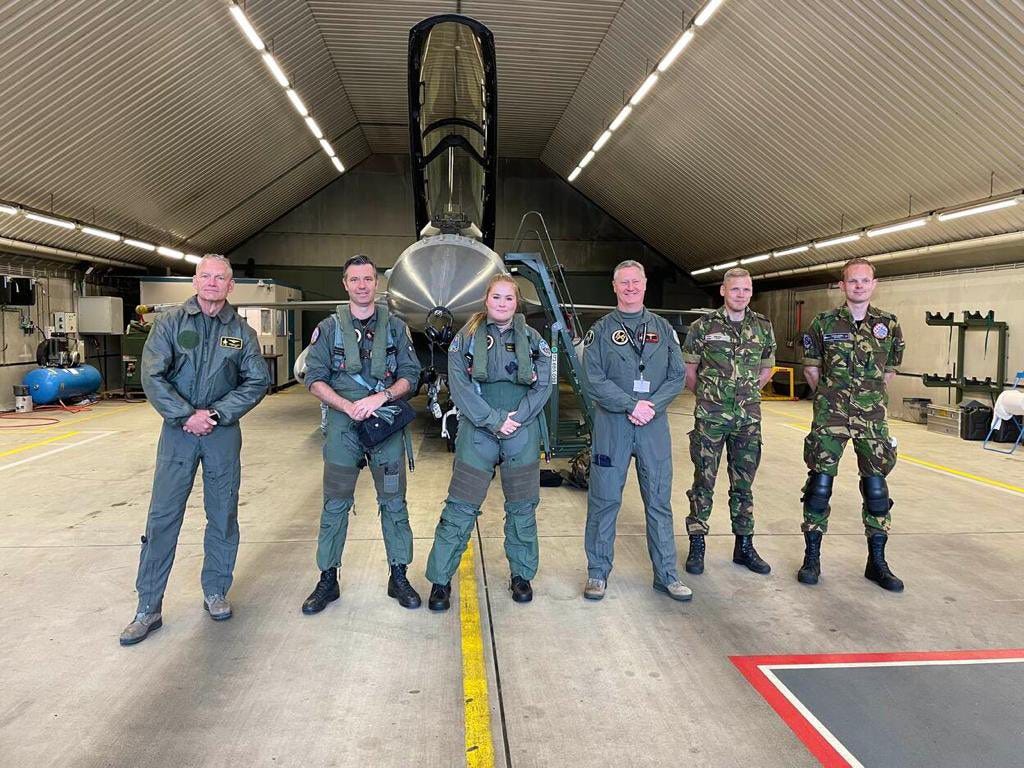
A country could host US nuclear weapons and not want to use them (like Turkey), in which case they would not need any Service-Level Agreements. But, if they want to join the mission, they have to certify their aircraft as dual-capable - any F-16 or Tornado can be modified, and all F-35As can be certified (in theory, it’s not that hard to modify any aircraft to deliver a B61, don’t let them fool you - it’s a matter of load and lift and running the controls to the cockpit and connecting the electronics to the nuclear targeting net). So, if they want that, then:
A Service-Level Agreement between USAFE and the host Air Force.
Easy: certify all Allied F-35As for DCA whether they host nuclear weapons or not
So, instead, what is far more likely is that Allies the currently do not participate in the DCA mission, but have purchased F-35As, will certify them to supply SACEUR with more airframes for the nuclear mission should the time come. Remember, the current nations that fly DCA (Belgium, Germany, Italy, and the Netherlands) only have so many certified F-35A, F-16, and Tornado aircraft ready to go. And even those aircraft need repairs, pilots and flight crews might be unavailable, and all of them might also be needed for conventional missions.
I haven’t mentioned SNOWCAT/CSNO here, and I don’t intend to. Don’t @ me.
But if you look at the future Allied totals, based on order, you get a potential DCA force of F-35As that looks like this:
Belgium: 34
Germany: 35
Italy: 75
Netherlands: 57
A total of 201 F-35As - not bad - not including the F-16s and Tornados from these four that are not yet retired. That’s pretty good, but not quite enough. Then you throw in the UK purchase of 12 F-35As out of their total F-35 purchase for a roll call of 213 F-35As certified for the NATO nuclear misison out of the countries that currently host US nuclear weapons.
But what about expanding the pool to include certification of Allied F-35As from countries that do not host nuclear weapons? There’s no legal requirement for a 144b Agreement or a Stockpile Arrangement. You might need a modified Service-level agreement, but that requires no Congressional approval and is easy enough to do. What would that add to the DCA fleet?
Belgium: 34-45
Canada: 88
Czech Republic: 24
Denmark: 43
Finand: 64
Greece: 20-40
Norway: 52
Poland: 32
Romania: 32-48
Greece would be the easiest, as they already had all three agreements in place when they left the nuclear mission back in 2001 when the US pulled its nuclear weapons from Araxos Air Base and its MUNSS was inactivated (later redesignated as the 731st MUNSS at Aviano). Greece has remained in STEADFAST NOON (at least as of 2024), so that should be easy. This would give us an additional 389-436 for a total of between 600-650 F-35As if we go down the route of additional certifications.
In other words, if NATO Allies certify all F-35As for the nuclear mission, they will triple the number of F-35As available to SACEUR.
Now to the final part - DOB and UOB.
Dispersal versus Untethered Operations
In the Cold War, NATO had what was known as Dispersed Operation Bases (DOBs), that is, Allied air bases other than the established permanent storage bases, with certified and secured equipment in place to accept nuclear armed aircraft and provide them with maintenance and support for strikes.
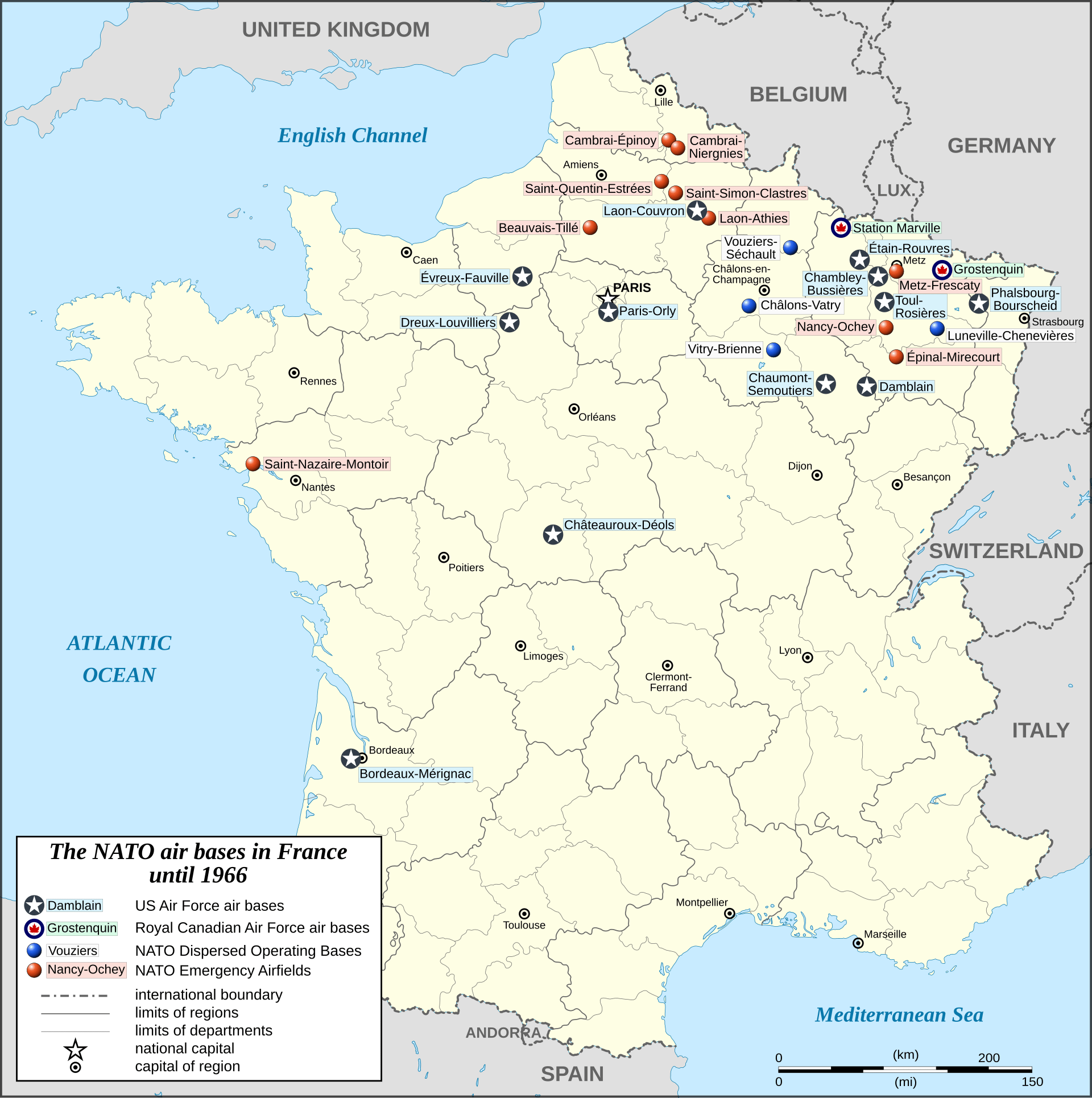
NATO should have numerous Dispersal Operation Bases (DOBs) and Untethered Operation Bases (UOBs) as it did in the Cold War. Bringing back DOBs and UOBs would address one of the core challenges posed by Russia if it strikes first:
Currently, Russia can destroy all NATO DCA and US nuclear weapons in Europe by striking a total of seven air bases.
In the Cold War, USAFE planned to divide the larger NATO DCA wings into squadron-sized units and disperse them no less than 30 miles apart. That would increase the number of units the Soviets would have to worry about from around 15 to more than a hundred separate air bases. The Untethered Operation Base goes even further.
The UOB concept is being developed by the U.S. Air Force for the European and Pacific operations, with more than 400 eligible bases and many, many more suitable austere locations. UOBs are air bases or other austere locations (such as highways – a capability routinely demonstrated by Allies for conventional air operations) suitable for launching strikes, but with no pre-positioned equipment or other indicators that they would host NATO strike aircraft prior to dispersal.
Such a posture would complicate Russian targeting massively if SACEUR disperses the DCA early in a crisis, increasing the number of targets Russia would need to strike to disarm the Alliance from seven to several hundred, across an increase in target countries from six to potentially all 32.
What would this take? Well, a DOB might require a 144b Agreement. I’m not sure - a lawyer would have to parse that. You could argue that in a pre-war crisis, all bets are off. A UOB would not require such any such agreements, as that would unnecessarily call attention to an arrangement you do not want Russia to notice.
And all of this may very well be underway…